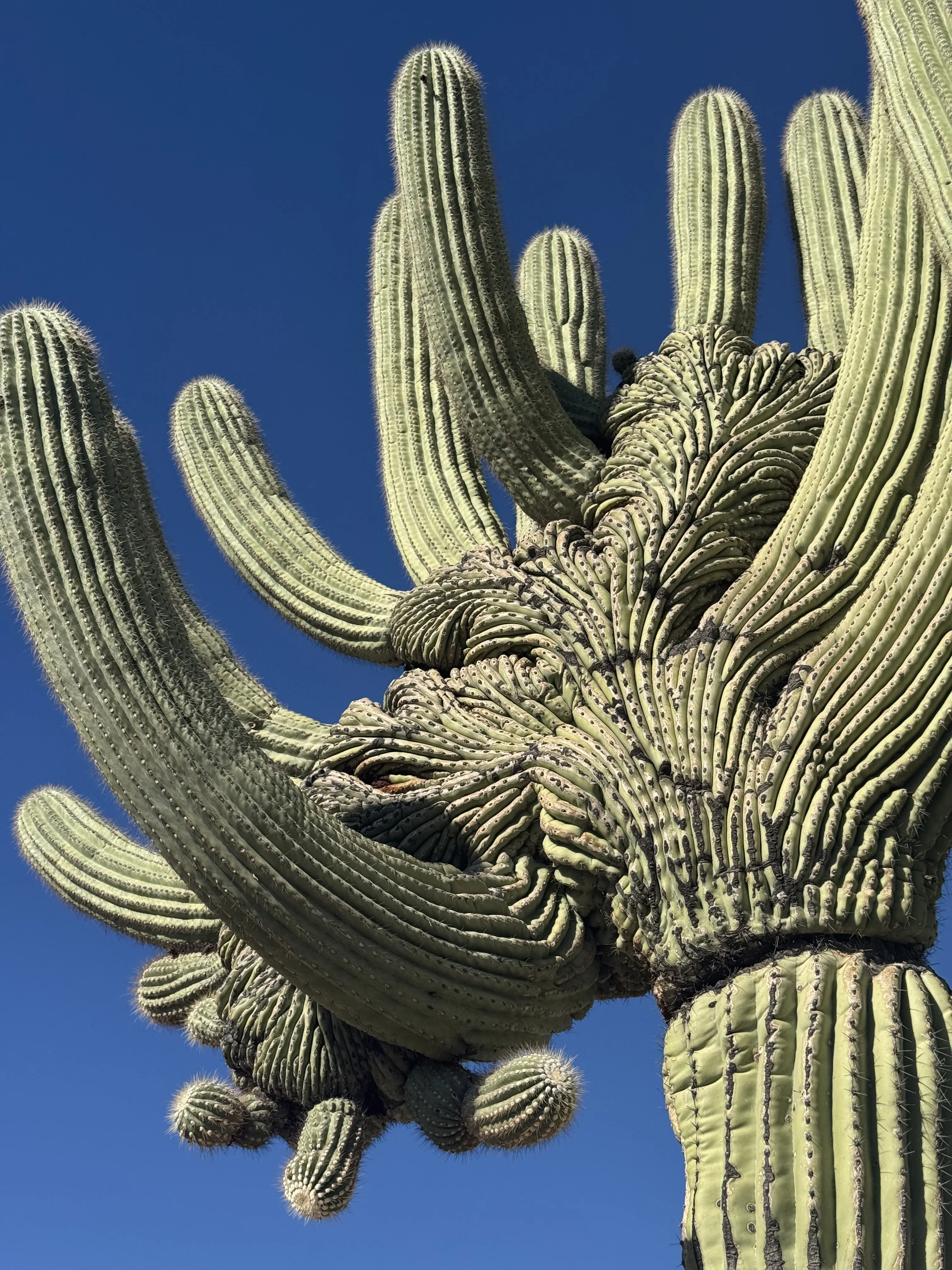
The image succeeds because the photographer recognized an extraordinary subject and got physically close enough to let the form overwhelm the frame — that decision is correct and not obvious. The hard light from the right does exactly what it needs to do: it rakes across the ribbing and reveals texture that softer light would flatten. The weakness is that the image remains primarily a document of a remarkable thing, and the formal decisions — while sound — do not yet transform the subject into something beyond itself. The composition is accumulative rather than decisive. With tighter cropping to isolate the crested mass against sky, or a second frame that finds the single angle where chaos resolves into order, this moves toward exhibition.
- Formal
- The frame is organized around the crested fasciation growth — the biological aberration becomes the compositional anchor. The camera is positioned low and close, tilted upward so the mass of crested tissue occupies the center-left while normal saguaro arms radiate outward and upward, filling the frame with organic geometry. There is no horizon, no ground — only cactus against sky. [object Object]
- Technical
- Critical sharpness falls on the crested fasciation at center-left. The ribbing and spine detail in this zone is precise. Arms in the upper frame lose some acuity, consistent with the phone's computational depth rendering rather than optical bokeh. Accurate for the dominant midtones. The sky retains saturation and detail. The shadowed recesses within the crested growth go deep but do not fully block — some interior texture is preserved. No apparent highlight clipping on the sunlit surfaces. Competently handled by the iPhone's computational pipeline. The simultaneous retention of sky blue and shadow detail in the folds suggests HDR processing. The result is clean without feeling artificial.
- Semantic
- This is not a landscape image — it refuses distance. The photographer has moved inside the subject, treating the cactus as architecture to be entered rather than scenery to be recorded. The biological anomaly is presented as spectacle of form: nature producing something that looks carved, deliberate, almost anthropomorphic.
- Historical
- New Objectivity — the thing presented precisely on its own terms; Close-up botanical and natural form photography; American Southwest landscape tradition refracted through the macro lens; [object Object]; [object Object]; [object Object]
- Curatorial
- Physical proximity and upward angle correctly prioritize the crested fasciation as subject, refusing the safe wide shot Hard raking light from the right reveals the three-dimensional complexity of the ribbing and folds with precision The blue sky as negative space is clean and gives the tonal chaos of the cactus somewhere to breathe against